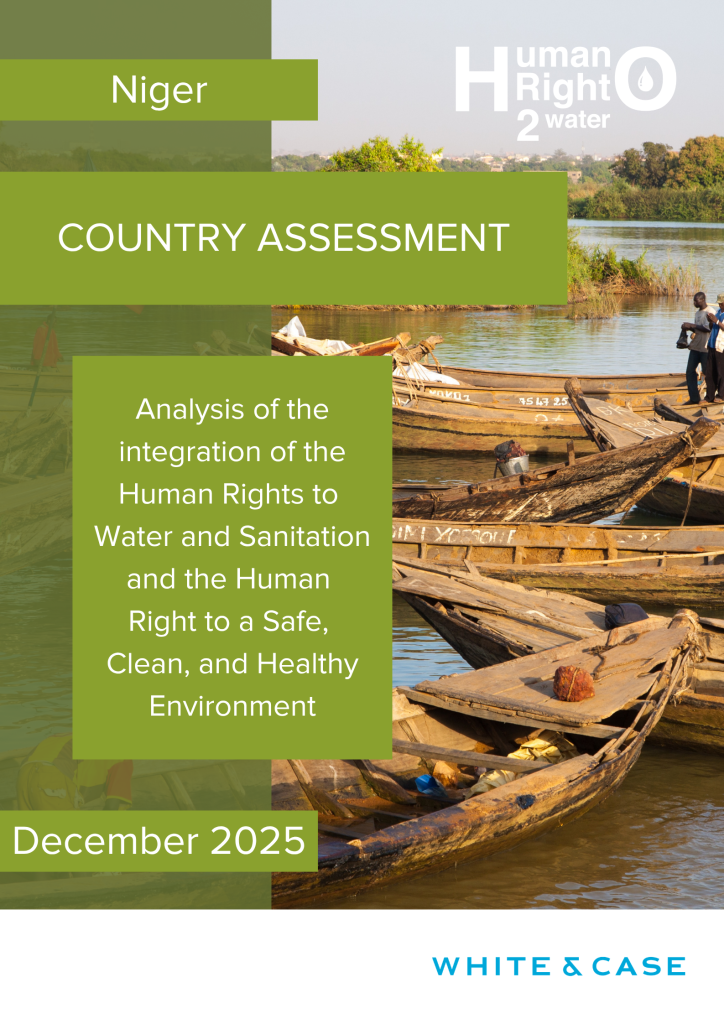
Niger’s Commitment to Water Justice: Balancing the Scale of Human Rights and Environmental Protection
by Chelsea Agbasiere
In West Africa, the Republic of Niger has laid down a structured legal, policy and institutional framework with a pathway for its citizens to achieve the Human Rights to Water and Sanitation (HRWS) and Human Rights to Healthy Environment (HRHE). Firstly, with its Constitution providing for the HRWS and HRHE, followed by a synergy created in its laws and policies to ensure the realisation of these rights; Niger has become one of the nations that brings ecological integrity as a yardstick to good governance.
Rights on Points of Law: Constitutional Foundations and Legal Frameworks
The Nigerien constitution and legal frameworks exemplify a comprehensive framework of the distinct yet interconnected rights that model the groundwork of human dignity. Article 12 of the Constitution provides for the right to potable water and Article 100 provides for the fundamental principles of the Water and Food Security Code.
The provisions for HRHE are quite elaborate and not merely symbolic as Article 35 creates a legally binding obligation on the state to protect the environment, for the present and future generations, thereby embedding the principle of intergenerational equity in their fundamental norms. The provision also mandates that the State ensures evaluation and control of impacts of any project on the environment. Article 37 reinforces this by mandating all enterprises including multinational corporations (MNCs) to respect legislations in force on environmental matters, thus aligning with the ‘Respect’ principle from the UNGP Principles on Business and Human Rights of protect, respect, and remedy; This demonstrates how businesses have an obligation to prevent environmental harm, by addressing contexts where environmental degradation could be seen as most prevalent, such as the exploration and mining zones within the Sahel and around the Niger River basin.
Additionally, Article 100 provides principles for the protection of the environment and conservation of natural resources. The responsibility for transparency and public accountability in the exploitation of natural resources and environmental protection is mandated in Article 149, an imperative protection for regions impacted by resource exploitation. Article 172 provides for international cooperation in preservation of the environment thus imbibing Niger’s domestic laws and aspirations with global commitments.
More legal frameworks for these rights include the Water Code 1998, which regulates access and usage of water resources and the Operational Strategy for the Promotion of Hygiene and Basic Sanitation (PROSEHA, 2016-2030) which details procedures for improving hygiene and sanitation across Niger, particularly in the rural areas. Insights from the Rural Code 1993 showcase the commitment to reduce legal pluralism while also protecting traditional rights to water, forests, and sustainable resource management. Niger has additional frameworks for the realization of these rights, for example the National Policy on Environmental Protection complemented by the National Integrated Water Resources Management Plan (PANGIRE 2017-2013) both providing a broader effort at unifying environmental and water resource management through a coordinated multisectoral approach, amongst others.
Bringing Rights Closer to People from Ground Up: Institutional Architecture
Niger’s multifaceted approach to the governance of these rights showcases an appreciation for their interconnectedness. For example, the institutional architecture and oversight of these thematic areas span across multiple ministries, commissions, and agencies at the federal level and across the regions and local levels.
At the national level, the Ministry of Hydraulic and Sanitation serves as primary water and sanitation authority. Within this Ministry, two technical departments operate; the Direction Generale de l’Hydraulic responsible for water management and the Direction Generale de l’Assainissement oversees sanitation management and infrastructure. The Ministry of Public Health provides oversight on water quality and public health implications of WASH. Lastly, the Ministry of Environment and the Fight Against Desertification acts as the central coordinating body. Other government institutions include the National Water and Sanitation Commission which supports interministerial coordination and implementation.
At the regional and local levels, Article 105 of the General Code of Territorial Communities empowers regional authorities the powers to make policies in line with health and environmental issues, to adapt national policies to their local contexts, communes and local authorities, thereby ensuring that HRHE and HRWS and hygiene are responsive to the needs of different populations.
A Model for Rights-Based Development: Conclusion
Niger’s approach offers lessons for other countries struggling with water, sanitation and ecological challenges. There is a strategically designed human rights-based approach to governance which includes: constitutionally recognising these rights, integrating them in other legal and policy frameworks, creating specialised institutions, integrating interministerial coordination, decentralisation, regional cooperation, and aligning them with international laws and principles.
The distinct recognition that water, sanitation, and environmental rights are interconnected provides a laudable model for addressing the root causes of underdevelopment rather than at the peripheral. Although challenges exist which may restrict access to these rights, such as rapid population growth, institutional pressures, climate change factors, low community awareness and implementation/enforcement challenges amongst others, Niger’s model offers valuable insights reflecting that human rights issues require commitment, institutional strategy and community participation.
