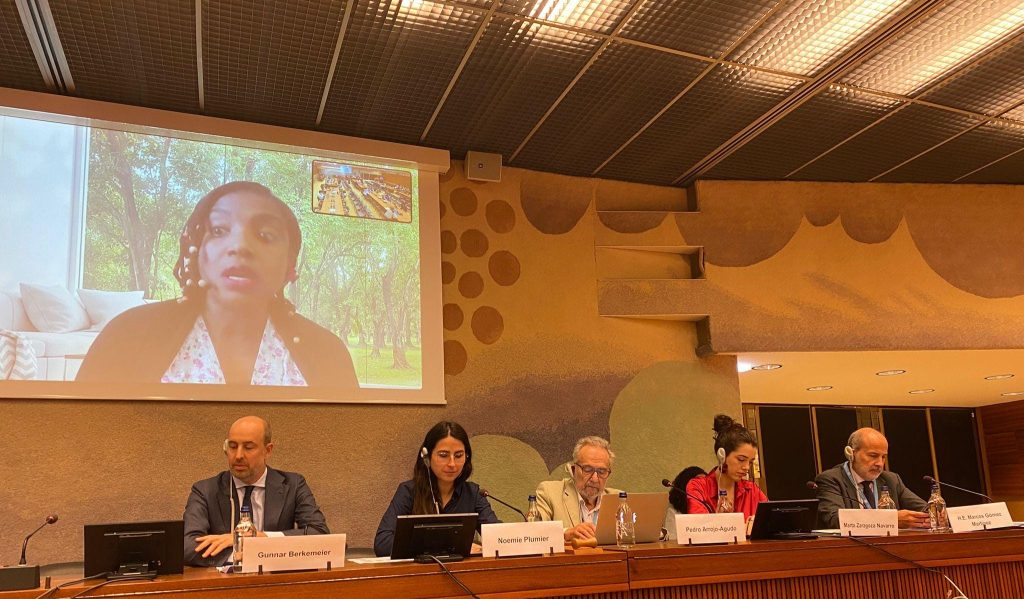
On June 26, 2025, a vital side event titled “Voices from Civil Society: What We Expect of the 2026 UN Water Conference” took place at the Palais des Nations in Geneva, following the Human Rights Council’s panel discussion on water and human rights held earlier that day. Hosted by the Permanent Missions of Spain and Germany in the UN and by Human Right 2 Water, this event is designed to ensure that civil society perspectives are not just heard—but prioritized—in the lead-up to the 2026 UN Water Conference.
The event was moderated by Noémie Plumier representing Human Right 2 Water, introduced by Dr Pedi Obani, President of Human Right 2 Water and closed by Pedro Arrojo Agudo, Special Rapporteur of the human rights to safe drinking water and sanitation.
This hybrid-format event was able to spotlight diverse and under-represented voices, focusing on the human rights to water and sanitation through the lens of five key standards: availability, accessibility, quality, acceptability, and affordability. With participation from youth leaders, Indigenous representatives, and global advocates for women’s health and water access, the event brought attention to the realities faced by communities on the front lines of water insecurity.

Among the powerful voices sharing their experiences and expectations:
- Marta Zaragoza Navarro (World Youth Parliament for Water, Spain) highlighted the urgency of addressing water security in the context of climate change. She emphasized how the coalition has empowered young experts to effectively represent their expertise—becoming the first active youth coalition with the capacity to engage in negotiations at the ministerial level.
- Samira Shakya (Freshwater Action Network South Asia, Nepal) spoke on access to water and sanitation in rural communities. Samira highlighted the challenges faced by marginalized communities in Southeast Asia, where over 600 million people live with poor hygiene, widespread open defecation, and severely polluted water. Those living below the poverty line, especially persons with disabilities, face systemic barriers to accessing safe water. Climate change and weak policy implementation worsen these inequalities. With over 600 members in the Southeast Asian network, she emphasized that the 2026 UN Water Conference is a crucial moment to reaffirm that access to water and sanitation is a fundamental human right—not a privilege.
- Daniela Araya and Mrs. Dallis Morris, representing the Guna Tribe from Panama (via video), shared Indigenous perspectives on water quality and conservation. Through the GEF CREW+ project, Daniela introduced the work that is happening to support women and girls, the disabled and the LGBT+ community to have improved availability of clean drinking water and accessible toilets.
- Arundati Muralidharan (Menstrual Health Action, India) emphasized the critical connections between menstrual health, sanitation, and women’s dignity and well-being. She underscored that Menstrual Health Management is not just about addressing physical discomfort, but a fundamental human right. Women and girls must be able to fully participate in society with access to safe sanitation, adequate water, and appropriate menstrual products that uphold their health, dignity, and inclusion.
- Mary Muia (Women for Water Partnership, Kenya) addressed the hidden burden of water affordability on African women. She addressed the critical issue of water affordability for marginalized communities in Sub-Saharan Africa and highlighted how millions lack basic services and some households are spending up to 25% of their income on water. She concluded with clear demands for the 2026 UN Water Conference to prioritize affordability, inclusive governance, and targeted investment.
This side event aimed to embed human rights at the core of the upcoming global water agenda. As preparations for the 2026 UN Water Conference gather momentum, this side event calls for concrete commitments to participation, accountability, and equity in global water governance.
